Today Warren Buffet took out an ad in the New York Times ( http://www.cnbc.com/id/32473352) and proceeded to tell us about the unintended consequences of preventing a financial collapse due to government involvement.
He says that the billions of dollars borrowed by the Federal Government is justified but that we need to be careful because this policy is inherently inflationary.
Memo to Warren Buffet: No shit!
Oh as an aside, his greatest is fear is that when the time comes politicians will lack the political will to put the brakes on to prevent inflation. I believe that is a given, oil is back up to $72/bbl today and I believe the market is pricing in this complete lack of backbone because supply and demand do not justify this price.
The 12 trillion dollar question is when does the deflationary cycle end and when does the inflationary cycle start?
Perhaps he would have been better off explaining the liquidity traps of the fractional reserve banking system. Until the Federal Government side steps these flooding the market with money will not happen, all that will happen is a balance sheet transfer. The Federal Government will sidestep the liquidity trap when people start demand jobs and civil unrest becomes a real possibility, I am sure this is the time when they will develop the backbone to hike interest rates to 25% and reduce liquidity.
I saw it presented this way earlier.....
Deflation = Default on sovereign debt = We're Screwed.
Inflation = Monetization of sovereign debt = We're Screwed.
Pick your poison
Showing posts with label inflation. Show all posts
Showing posts with label inflation. Show all posts
Wednesday, August 19, 2009


Tuesday, August 18, 2009
Are Stocks Going to Test New Lows?
Since March the stock market (S&P 500) has moved from 666 to over 1000, that is a move of 50%. Initially it was a move to relieve the oversold conditions from the big drop started in the fall of 2008, figuratively and literally. The next part of the rally, I believe, was caused by the reflation trade.
The reflation trade says that because of the massive debt incurred by the US Government that the value of the dollar will weaken substantially over time. Since stocks represent actual "things" they will get more valuable as the value of the dollar decreases along with commodities like Gold, Oil, Coffee, Frozen Concentrated Orange Juice, etc.
The "thing" that the Fed wanted to prevent in the midst of the credit crisis was deflation, this would be a disaster for the economy. Home prices and the prices of all other asset classes would decline and worst of all the debt incurred to pay for those rapidly shrinking assets would be more in nominal dollars. To combat this the Fed rolled out 7 trillion in aid and backstops giving us a "shadow" government and an alphabet soup of Federal Programs: TARP, TALF, Cash for clunkers, etc. This all lead to a fear of inflation and a rise of oil to $70/bbl, gold to just under $1000/oz, and a stock market up from 666 to 900.
To make the jump from 900 to 1000+ the stock market needed more fuel and got it in the form of earnings season. First the banks showed an amazing ability to make money when they could mark their bad assets at the price they paid for them and collect 11% interest on money they borrowed for free. Throw in some one time asset sales and the banks had a fantastic quarter. Next was the Fortune 500 companies, their earnings looked all the same. Top line revenue down about 25% but due to aggressive cost cutting there was a good profit on the bottom line. This was the fuel to take the market up some more.
Here is the problem with the runup...it counts on inflation in the next 6 to 12 months unfortunately for Uncle Sam I just don't see it. Right now we are in a deflationary spiral and as odd as this sounds unless the Federal Government finds a way to spend money somewhat efficiently in the "real" economy increasing the money supply it will be deflation city. Right now all of the money that the Fed has borrowed is just sitting there as a backstop to banks as loss reserves. This means when a foreclosed house gets written off (x100,000) the federal government will step in and bail the bank out allowing the bank to stay solvent and effectively transferring the debt from the private sector to the public sector.
The Government has not/cannot borrow enough money to put the entire private sector debt onto it's books, it is only putting a very small fraction of it. In the meantime the consumer will continue to tighen his/her belt by deleveraging. This is a little confusing so pay attention. When you or I do not spend (consume) with our money it is by defination "saving". Now this savings didn't go into a christmas account, cd's, or money market account it went to pay down their debts.

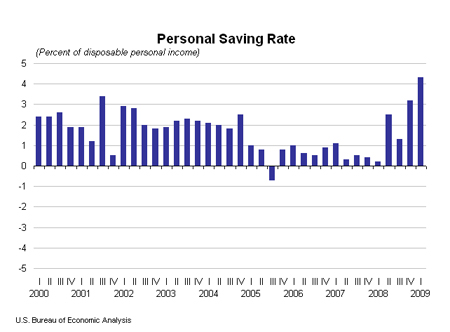
We are now a year into the beat deflation experiment and we are starting to get tangible results in. With the enormous amount of borrowing being done at the Federal level surely inflation must be starting to rear it's ugly head.... Not so much.
Today Housing starts came out and they were at 581k a decrease from last months 587k and more importantly the Producer Price Index came in at -1% meaning the cost of doing business actually went down by 1%. Couple this with an industrial output running at 69% of capacity and 10% unemployment and it seems deflation has the wind at it's back.
This is bad, bad, bad for the market. Stocks are trading for absurd P/E levels because inflation is "baked" into the price, everybody (banks included) just had a one off quarter and will be hard pressed to repeat, and global consumer demand is down. I am not saying stocks will go down, I just don't see the catalyst to take us higher and in all likelyhood we will test the lows sometime soon.
It seems we have a choice as a country now... live in a deflationary enviroment or bypass the traditional fractional reserve banking system and make direct cash injections into the economy which will absolutely cause inflation. The clock is ticking.
The reflation trade says that because of the massive debt incurred by the US Government that the value of the dollar will weaken substantially over time. Since stocks represent actual "things" they will get more valuable as the value of the dollar decreases along with commodities like Gold, Oil, Coffee, Frozen Concentrated Orange Juice, etc.
The "thing" that the Fed wanted to prevent in the midst of the credit crisis was deflation, this would be a disaster for the economy. Home prices and the prices of all other asset classes would decline and worst of all the debt incurred to pay for those rapidly shrinking assets would be more in nominal dollars. To combat this the Fed rolled out 7 trillion in aid and backstops giving us a "shadow" government and an alphabet soup of Federal Programs: TARP, TALF, Cash for clunkers, etc. This all lead to a fear of inflation and a rise of oil to $70/bbl, gold to just under $1000/oz, and a stock market up from 666 to 900.
To make the jump from 900 to 1000+ the stock market needed more fuel and got it in the form of earnings season. First the banks showed an amazing ability to make money when they could mark their bad assets at the price they paid for them and collect 11% interest on money they borrowed for free. Throw in some one time asset sales and the banks had a fantastic quarter. Next was the Fortune 500 companies, their earnings looked all the same. Top line revenue down about 25% but due to aggressive cost cutting there was a good profit on the bottom line. This was the fuel to take the market up some more.
Here is the problem with the runup...it counts on inflation in the next 6 to 12 months unfortunately for Uncle Sam I just don't see it. Right now we are in a deflationary spiral and as odd as this sounds unless the Federal Government finds a way to spend money somewhat efficiently in the "real" economy increasing the money supply it will be deflation city. Right now all of the money that the Fed has borrowed is just sitting there as a backstop to banks as loss reserves. This means when a foreclosed house gets written off (x100,000) the federal government will step in and bail the bank out allowing the bank to stay solvent and effectively transferring the debt from the private sector to the public sector.
The Government has not/cannot borrow enough money to put the entire private sector debt onto it's books, it is only putting a very small fraction of it. In the meantime the consumer will continue to tighen his/her belt by deleveraging. This is a little confusing so pay attention. When you or I do not spend (consume) with our money it is by defination "saving". Now this savings didn't go into a christmas account, cd's, or money market account it went to pay down their debts.
We are now a year into the beat deflation experiment and we are starting to get tangible results in. With the enormous amount of borrowing being done at the Federal level surely inflation must be starting to rear it's ugly head.... Not so much.
Today Housing starts came out and they were at 581k a decrease from last months 587k and more importantly the Producer Price Index came in at -1% meaning the cost of doing business actually went down by 1%. Couple this with an industrial output running at 69% of capacity and 10% unemployment and it seems deflation has the wind at it's back.
This is bad, bad, bad for the market. Stocks are trading for absurd P/E levels because inflation is "baked" into the price, everybody (banks included) just had a one off quarter and will be hard pressed to repeat, and global consumer demand is down. I am not saying stocks will go down, I just don't see the catalyst to take us higher and in all likelyhood we will test the lows sometime soon.
It seems we have a choice as a country now... live in a deflationary enviroment or bypass the traditional fractional reserve banking system and make direct cash injections into the economy which will absolutely cause inflation. The clock is ticking.
Wednesday, August 12, 2009
Pent up Supply???? June Housing Report In.
First a couple of facts: People want a new (different) car every 2.5 years and a new (different) house every 5 years. After these time periods pass consumers develop an "itch" to change. In economics this is called pent up demand, it is the reason we usually explode out of recessions. We HAVE to have the latest, greatest car/neighborhood etc. Since "the consumer" is 70% of economic activity in this country this itch coupled with easy credit is a recipe for economic success. Unfortunately I am not seeing this happening right now.
From Barron's (Click on blog title to go to article):
The median price of an existing single-family home dropped to $174,100, the most in records dating to 1979, the National Association of Realtors said today. Total sales rose 3.8 percent to a seasonally adjusted annual rate of 4.76 million from the first quarter and fell 2.9 percent from 2008’s second quarter.
So we must be at a bottom right? Prices are going to rocket from here, right?
“I don’t think we’re at a bottom yet in home prices,” said Scott Anderson, a senior economist at Wells Fargo & Co. in Minneapolis. “There’s also a pretty big shadow supply of houses. People are kind of waiting for the bottom but there’s a pent-up supply out there.”
Pent up supply???? Don't you mean pent up demand? Most people have mortgages on their properties, when they sold their house in 2006 the could do 2 things with the equity: Spend it on jetskis, cars, vacations, or a myriad of other things they didn't really "need" or they could have rolled it into their new house letting them buy a bigger house than they could otherwise afford in a sense leveraging themselves up. Turns out home values have gone down and all that equity is gone, how much the homeowner is underwater is dependent on how much they put down on their "new" crib. Between being underwater, having the moving itch, and/or being unemployed the consumer just wants the pain to end and is looking for any bounce in the market to sell their property. In the stock market they call it "being trapped" and believe me there is tremendous supply above these levels with people waiting to liquidate their 401k's.
That is just consumer supply. The banks also have alot of supply on their books and also are looking for any sort of market bounce to unload their foreclosures/delinquent loans. Theoritically they should just take the hit and liquidate them but then they would have to realize the loss on their books. Once these loans enter the stormy waters of mark to market accounting ( a fancy word for how much something is actually worth) then the banks would be exposed for the insovent insitiutions they are.
From the Congressional Oversight Panel (http://cop.senate.gov/documents/cop-081109-report.pdf )
The uncertainty created by the financial crisis, including the uncertainty attributable
to the troubled assets on bank balance sheets, caused banks to protect themselves by
building up their capital reserves, including devoting TARP assistance to that end. One
byproduct of devoting capital to absorbing losses was a reduction in funds for lending and a
hesitation to lend even to borrowers who were formerly regarded as credit-worthy.
As far as I can tell the only way out of this dilemma for both the banks and the consumer is inflation. On the plus side the Federal Government is excellent at spending money.....
From Barron's (Click on blog title to go to article):
The median price of an existing single-family home dropped to $174,100, the most in records dating to 1979, the National Association of Realtors said today. Total sales rose 3.8 percent to a seasonally adjusted annual rate of 4.76 million from the first quarter and fell 2.9 percent from 2008’s second quarter.
So we must be at a bottom right? Prices are going to rocket from here, right?
“I don’t think we’re at a bottom yet in home prices,” said Scott Anderson, a senior economist at Wells Fargo & Co. in Minneapolis. “There’s also a pretty big shadow supply of houses. People are kind of waiting for the bottom but there’s a pent-up supply out there.”
Pent up supply???? Don't you mean pent up demand? Most people have mortgages on their properties, when they sold their house in 2006 the could do 2 things with the equity: Spend it on jetskis, cars, vacations, or a myriad of other things they didn't really "need" or they could have rolled it into their new house letting them buy a bigger house than they could otherwise afford in a sense leveraging themselves up. Turns out home values have gone down and all that equity is gone, how much the homeowner is underwater is dependent on how much they put down on their "new" crib. Between being underwater, having the moving itch, and/or being unemployed the consumer just wants the pain to end and is looking for any bounce in the market to sell their property. In the stock market they call it "being trapped" and believe me there is tremendous supply above these levels with people waiting to liquidate their 401k's.
That is just consumer supply. The banks also have alot of supply on their books and also are looking for any sort of market bounce to unload their foreclosures/delinquent loans. Theoritically they should just take the hit and liquidate them but then they would have to realize the loss on their books. Once these loans enter the stormy waters of mark to market accounting ( a fancy word for how much something is actually worth) then the banks would be exposed for the insovent insitiutions they are.
From the Congressional Oversight Panel (http://cop.senate.gov/documents/cop-081109-report.pdf )
The uncertainty created by the financial crisis, including the uncertainty attributable
to the troubled assets on bank balance sheets, caused banks to protect themselves by
building up their capital reserves, including devoting TARP assistance to that end. One
byproduct of devoting capital to absorbing losses was a reduction in funds for lending and a
hesitation to lend even to borrowers who were formerly regarded as credit-worthy.
As far as I can tell the only way out of this dilemma for both the banks and the consumer is inflation. On the plus side the Federal Government is excellent at spending money.....
Subscribe to:
Posts (Atom)