Thursday, September 3, 2009

Gold to Break $1,000 an ounce


Gold has been consolidating for months now and a large move has been expected. The big question is whether it is going to be up or down. The Jury is still out on that but Gold has been an absolute beast the past two days up over 3.5% with the biggest move since March. As I write this Gold is $992/oz just $8 shy of $1,000/oz.

$1,000/oz is HUGE. It is the upper technical boundry for the consolidation triangle and it is a giant psychological boundry. Gold could very well hit $999.99 and start heading back down but I wouldn't bet against it right now, every dip is being bought.

So why is it going to $1,000/oz? Fear. Fear of a crash, Fear of Inflation, Fear of Deflation, and Fear of Counter Party Risk (Paper Money). Very rarely do so many camps agree on one asset class but the stars have aligned and right about now it looks like destiny.

Retailers Report Back to School Results: Not God Awful...Just Bad


August 2009 "Same Store Sales" came out for the retailers today, they were considered an upside surprise. August is traditionally the month in which parents run frantically around town looking for dry erase markers, tissues and "pants that fit" for their youngins. It is expected that these sales would be down from a weak 2008 back to school season and they didn't disappoint. Starting next month we get an apples to apples comparison as both months will be post crash, although I suspect next month will be a "beat" also as the entire system was locked up in September 2008.

Back to the chart above, lifted from www.ZeroHedge.com, it shows me that the consumer is still deleveraging. This means that spending is generally down and specifically up at where the consumer gets the most bang for his/her buck. I don't suspect this will change anytime soon.

Monday, August 31, 2009

Tax Stock Transactions...Idea of the year?


Let's please get one thing straight Wall Street isn't capitalism at it's best it is more like a casino on a Cruise ship. You know going in the deck is stacked against you but you are hoping that your talents will overcome this house edge.

There are some sure things, riskless bets if you will but they are only available to the very upper crust of the trading community. I do not have access to the server room at Nasdaq nor do I have the high frequency trading programs that Morgan Stanley or Goldman Sachs have. High Frequency trading is where volume is artificially produced in the market when a computer can see the bid and ask before anyone else can buys the ask adds a fraction of a penny and sells to the bid in under a second. A Completely unnecessary middle man, some might even call it illegal front running.

Next huge factor in the Rigged Casino... Dark Pools. From the NY Sun (http://www.nysun.com/business/dark-pools-threaten-wall-street/64598/):

'Dark Pools' Threaten Wall Street

By LIZ PEEK, Special to the Sun | October 16, 2007

One of the fastest moving trends on Wall Street has flown under the radar of individual investors and, seemingly, the Securities and Exchange Commission: the rapid rise of "dark pools" stock trading arenas.

As the name suggests, dark pools lack transparency: They are used by institutional investors seeking to trade large blocks of stocks without creating the price wobbles that routinely accompany such moves. The trading is done away from the traditional exchanges, offering unprecedented anonymity.

Recently, more than 20% of all trades in New York Stock Exchange-listed stocks have been funneled through these dark pools, up from just 3% to 5% two years ago, according to NYSE figures.

Asked about the SEC's view of dark pools, a spokesman cited a recent speech by the head of the Division of Market Regulation, Erik Sirri, who said that "while the increasing use of hidden orders may be troubling," the SEC believes the new venues are available to all market participants. He suggested that the SEC is not in the position of favoring one market model over another. It would appear that until the trend toward dark pools has a measurable impact on investors, the SEC is willing to be simply an observer.

In the wake of the subprime mortgage debacle of the past two months, the importance of transparency is obvious. The packaging and repackaging of impossibly shaky mortgages into sophisticated investment products resulted in securities that were overly complicated and not well understood, and that ultimately went bust and brought down an entire industry.

An increasing number of these dark pools are popping up — more than 35, it is estimated — that seek to match large buy and sell orders without recourse to the traditional trading discourse on stock exchange floors. This is not to be confused with electronic trading, which is not new. The electronic communication networks such as Archipelago and Instinet that started up in the 1990s changed trading forever by essentially replacing the matching efforts of the specialist with computers. The ECNs report trading data in a traditional manner — publicly.

Dark pools, by contrast, do not alert the market makers that a sizeable order has been placed. Instead, by breaking the orders into smaller pieces, computer programs match and execute the different segments of the order in hundreds of separate transactions. This slicing and dicing is very similar to the complex structures banks used to divide up subprime mortgage debt.

All the major investment banks have dark pools operations, such as Block Alert, owned by Merrill Lynch, and ACE, which is part of Citigroup. There are also independent firms such as Liquidnet, which now ranks as one of the top 10 brokers. None comes close to Sigma X, which is owned by Goldman Sachs, some say.

"Goldman is a leader in the area. They're way ahead of everyone else," a financial services analyst with Punk, Ziegel & Company, Richard Bove, said. "They have spent hundreds of millions of dollars on systems. They have more people in IT than they have traders or investment bankers. They want to drive the price of trading to a level that will drive most firms out of business."

The attraction of these dark pools is clear. If an insurance company, for instance, wants to unload 1 million shares of Deere & Co., it traditionally would have to phone its broker, who would then have to contact the floor of the New York Stock Exchange, and in the process information about the institution's intent to sell would begin to leak out to other traders. Presumably, the shares would come under pressure, and the seller would end up receiving less money for his stock.

The problem is that in using the dark pools, there is little way for sellers to assess whether they have received the best possible execution on the order. Although by law the participants have to print the trade on one of the exchanges, the information is after the fact, and not especially revealing.

This is especially the case if the broker has "internalized" the order. This popular activity allows brokers to match the order within their own shops, operating beyond the vision of other dealers and outside the spotlight of the SEC. Though internalization has always taken place, the development of crossing networks has greatly expanded the in-house opportunities.

This has an impact on the average investor by shrinking the amount of trading that is being funneled through traditional channels, and which is available for filling the orders that such small investors place through their brokers. That is, it reduces liquidity and transparency in the marketplace for the small investor, while enhancing it for the big players. Less liquidity means less opportunity for "price improvement," wider spreads, and, ultimately, more costly executions.

Also, over time, internalization will mean a continued consolidation in the brokerage industry. Those firms such as Goldman Sachs that have giant order flows already are obviously best positioned to fill orders in-house. They profit off a spread between the price they paid for a stock and the price they charge the buyer. While initially they are likely to seek narrow spreads so as to attract business, if there is a fall-off in the number of competitors, the spreads will likely widen.

Not everyone is against the rise in dark pools activity. Dark pools "are providing a critical service with new technology," a former chief of the SEC, Harvey Pitt, who now heads Kalorama Partners, said.

Others argue that the private trading could augment opportunities for self-dealing. In an op-ed piece written several years ago, Mr. Pitt acknowledged that trading firms often put their own interests ahead of their clients'. Especially troubling, and the centerpiece of an SEC investigation into Knight Securities, was the practice of using client orders to enhance the profitability of the firms' proprietary trading desks. It is hard to imagine that increasing nonpublic trading improves matters.

Finally, as more investors rely on complicated algorithms to perform the market making functions that were once the province of the specialist, the transparency of the marketplace will be forever diminished. This will not be a problem until it is a problem — just as the inadequate pricing of risk in the CDO market was not a problem until it became a problem.


The Government is Slow, Stupid and Corrupt. The smart money is always one step ahead it seems but the government has the ability to put a halt to these (2) grossly unfair practices right now. Charge a transaction tax of 1/10 of 1%. To the retail investor or an infrequent trader (say somebody who holds his stock for at least 1 minute) this tax isn't a dealbreaker. If you trade 25million shares a day this removes the arbitrage associated with High Frequency Trading. In the end the retail investor very well might pay the exact same price for stock purchased or sold but I would bet my bottom dollar people would rather pay it to Uncle Sam than Goldman Sachs.

If Dark Pools pay tax it will at least give the retail investor if there is accumulation or distribution going on (if the tax code is written properly).

Don't get me wrong the casino will still be rigged but the ridiculous market manipulations will be minimized and if it helps Wall Street find their back pocket and contribute to the tax rolls instead of sucking from them so much the better.

Inflation or Deflation... Gold as a Tell


Not sure if the chart will post correctly but please click on it. It is a 5 year chart of the GLD ETF. This ETF represents the price of 1/10 of an ounce of gold making it a very good proxy for physical gold. Notice the two lines I drew, it is currently going through a consolidation before it either goes to the moon or drops like a rock. The move is imminent and it means the market is trying to decide whether we are in the grips of inflation or deflation. When GLD breaks this triangle we will know.

From Stockcharts.com:

Flag, Pennant (Continuation)

Flags and Pennants are short-term continuation patterns that mark a small consolidation before the previous move resumes. These patterns are usually preceded by a sharp advance or decline with heavy volume, and mark a mid-point of the move.

Dell, Inc. (DELL) Pennant example chart from StockCharts.com

  1. Sharp Move: To be considered a continuation pattern, there should be evidence of a prior trend. Flags and pennants require evidence of a sharp advance or decline on heavy volume. These moves usually occur on heavy volume and can contain gaps. This move usually represents the first leg of a significant advance or decline and the flag/pennant is merely a pause.
  2. Flagpole: The flagpole is the distance from the first resistance or support break to the high or low of the flag/pennant. The sharp advance (or decline) that forms the flagpole should break a trend line or resistance/support level. A line extending up from this break to the high of the flag/pennant forms the flagpole.
  3. Flag: A flag is a small rectangle pattern that slopes against the previous trend. If the previous move was up, then the flag would slope down. If the move was down, then the flag would slope up. Because flags are usually too short in duration to actually have reaction highs and lows, the price action just needs to be contained within two parallel trend lines.
  4. Pennant: A pennant is a small symmetrical triangle that begins wide and converges as the pattern matures (like a cone). The slope is usually neutral. Sometimes there will not be specific reaction highs and lows from which to draw the trend lines and the price action should just be contained within the converging trend lines.
  5. Duration: Flags and pennants are short-term patterns that can last from 1 to 12 weeks. There is some debate on the timeframe and some consider 8 weeks to be pushing the limits for a reliable pattern. Ideally, these patterns will form between 1 and 4 weeks. Once a flag becomes more than 12 weeks old, it would be classified as a rectangle. A pennant more than 12 weeks old would turn into a symmetrical triangle. The reliability of patterns that fall between 8 and 12 weeks is debatable.
  6. Break: For a bullish flag or pennant, a break above resistance signals that the previous advance has resumed. For a bearish flag or pennant, a break below support signals that the previous decline has resumed.
  7. Volume: Volume should be heavy during the advance or decline that forms the flagpole. Heavy volume provides legitimacy for the sudden and sharp move that creates the flagpole. An expansion of volume on the resistance (support) break lends credence to the validity of the formation and the likelihood of continuation.
  8. Targets: The length of the flagpole can be applied to the resistance break or support break of the flag/pennant to estimate the advance or decline.

Even though flags and pennants are common formations, identification guidelines should not be taken lightly. It is important that flags and pennants are preceded by a sharp advance or decline. Without a sharp move, the reliability of the formation becomes questionable and trading could carry added risk. Look for volume confirmation on the initial move, consolidation and resumption to augment the robustness of pattern identification.

Everybody likes deflation...except the Fed


It should be no surprise that after the shock of this last fall that we are starting to see businesses pick up the pieces and some of the strong ones are starting to prosper. We can see this in the ISM Chicago Index which shows the pace of business picking up.

Between the business climate warming and housing bottoming out old "Uncle Buck" has risen from his deathbed and started to do a jig. The Stronger dollar is taking it's toll on oil prices, demand is still slack and since it's priced in dollars the stronger the dollar gets the cheaper ALL commodities get. This sounds like a healthy enviroment to me.

It is also deflationary, all the money the Fed has cranked up has gone to transfer the balances of troubled banks (bad mortgages, car loans and credit cards which is the American Consumer) onto the Federal Balance sheets. This has not expanded the money supply nor has the first tranche of the Federal Stimulus as any increase in spending by the Federal Government was met with reductions in spending from the States, a zero sum game.

So excess production capacity, high unemployment, low commodity costs and an unwillingness by banks to lend because they have to keep capital on hand to cover losses. If just left alone the economy would come roaring back, sadly that isn't going to happen.

The Fed needs inflation for (2) reasons: First, and this is paramount inflation is the exact same thing as devalued dollars. The same dollar buys less goods and services. Deflation is terrible for people/country in debt. Second, Inflation makes the banking institutions magically solvent. Infaltion would drive up housing prices making home owners "above water" and creating a market where homeowners can and will sell their houses instead of walking away from hopeless mortgages.

If the Fed lets its liquidity programs just "go away" they will still have to pay down the National Debt and high taxes will crush any recovery a crappy solution but much better than defaulting on our loans. If they find a way to "inject" liquidity into the consumer we get inflation, low tax rates, high interest rates, and high commodity prices.

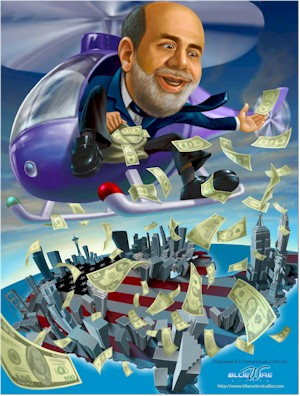
Ben just give me a heads up on which poison you are going to choose.

Friday, August 28, 2009

July Personal Spending Up .2%, Income Flat

While the whole world is fretting about the massive inflation that will hit the US Economy in 2012 they seem to skipping over the deflationary funk we are in. July personal spending inched up .2% which is just pathetic considering this time period covered the "Cash for Clunkers" sales promotion. Take away that once in a lifetime government giveaway and I think the personal spending number is actually negative. Income neither shrank nor grew during this same time period.

This is actually a healthy thing, the consumer is repairing their balance sheet. Thinking that the consumer is going to magically reappear is just not going to happen. Let me predict the future for you.... Back to school sales suck and Christmas sales suck. It's not that the American Consumer has lost their passion to consume but rather they are up to their eyeballs in debt and 20% of them are un/underemployed. Outside of buying staples and replacing things that break I think we can reasonably expect sluggish Personal Spending numbers for a long while.

What is important to remember is that the Government is NOT injecting liquidity (also known as cash money) into the consumer instead they are putting it in bank balance sheets. That money is there as loan loss provisions so when the unemployed can't make their Credit Card, Car or House Payments the banks that made these loans won't go under. They will get all the T-Bill money so that they can continue to exist.

This is being done under the guise of protecting the American/World Citizen from all the bad things that would happen if BofA, AIG, Fanny, Freddy, Citi and JPMorgan went belly up. What no one has done is calculate is the cost if they did go belly up and compare it to the cost of not letting them go belly up. I think as a country we choose wrong.

Wednesday, August 26, 2009

Do Some Shopping Dammitt

I would like to go on a cruise..... Now support your hard working blogger and do some shopping.....over there to the right..... ==========>