Thursday, September 24, 2009

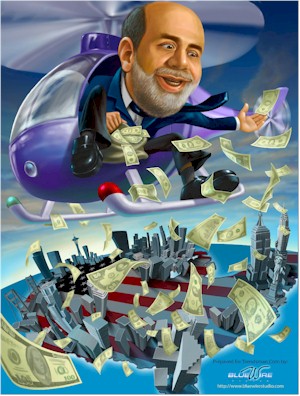
Is Creating Zombie Banks Better than Letting them Die?


Would you rather be dead or a Zombie? I'm taking dead, I've seen a lot of movies and it seems the life of an average zombie isn't too great.

All levity aside I am a little bit hot about the Federal Government squandering what time we may or may not have to shore up the financial system. It has been a year since Lehman Bros collapsed and we have done bupkiss to prevent it from happening again. I am not saying that it will happen again but it isn't a statistical improbability.

So instead of breaking up Citi, JPM, BofA, Wells Fargo and all the other systemic risk banks we mortgage our childrens futures to prop these insolvent POS's up so they can roam the countryside looking for brains errrrr overdraft fees. I just don't understand the thinking here, we only have a finite amount of resources to combat economic crisis. IF we have another one it will really suck when Uncle Sam has to tell the American public "I'd love to help but I'm tapped".

Unruly mobs on the street with pitchforks and torches might be the "Systemic Risk" the Government is talking about next.

Tuesday, September 22, 2009

Baltic Dry Index as a Proxy for Santa's Sled


Caught up in all the hype about the recession being over and stocks going to the moon is the fact the consumer has disappeared. It's understandable, like Pavlovian Dogs we have gotten conditioned to the credit bubble business cycle. Downturns are shallow and to be used as an opportunity to reload the shelves with cheap...errrr... inexpensive Chinese goods. It is natural for us to assume that economy is going to continue racing forward in 2010. I truly want this to happen, that would be fantastic but this little thing called reality is anchoring to me sober view.

Christmas is going to be rough for the retailers this year. The have put their bets on no one showing up in the stores. I know this because of the Baltic Dry Index which tracks the rates that sea going vessels charge on the open market. It is down....big. This tells me there is slack demand for container ships, which translates into less G-unit Gangsta Style Urban Parka's on the store shelves. So even if the consumer had their Credit Card limits restored and interest lowered to non mafia levels AND showed up to buy, buy buy! There would be nothing to buy.


This just isn't limited to the retailers, pick a sector of the economy and the story is the same. No sales begets no profits begets no earnings. It will be rough for stocks.

Monday, September 21, 2009

The Great Recession of 2008 is Over, but at what cost?


Today the "Leading Economic Indicators" came out for August 2009 and they showed a very slight improvement over the previous month. The economy has hit bottom and is bouncing, this is good news as I personally like a strong economy.

When all is said and done this "Recovery" will be regarded by historians as artificial because of the massive Government interference in the free market. I am not arguing that the interference was unwarranted, it was. Point blank the entire banking system would have collapsed worldwide within days. It probably needed to but I don't see anything good coming of that, "Gold Star" for the governments of the world....tight work.

This potential collapse of the banking system was the result of an easy credit bubble deleveraging. The only way to sustain the growth between 1990 and 2008 was with lots and lots of leverage.

So the US Government made liquidity available for banks and large businesses so that they wouldn't go under. I get that. What I don't understand is why they aren't writing off the losses that need to be written off in an ordered and measured fashion. The bubble still has to deflate. The only way to prevent the bubble from deflating is to blow a larger bubble. The Internet bubble begat the Housing bubble begat the commodities bubble. Each succeeding bubble requires more capital borrowed from future generations and this is only sustainable for a finite period of time. A Ponzi scheme can get only so large before every man, woman and child on the planet is a member of it and further growth is impossible, leading to it's collapse.

So right now we are borrowing growth from the future to finance such things as cash for clunkers, home buying credits, reduced payroll taxes, and the "stimulus" package. This is breathing life into the economy and we have bounced off the bottom. Good Times!

We really shouldn't, we should let the market have it's correction. It won't be fun and many people will be hurt, I would hope that we would spend some of the Government Largesse helping these people, but it needs to happen. We are going to spend our children's inheritance making sure the zombie banks of Citi, JPMorgan, BofA and Goldman Sachs can continue to not lend, loose buckets of money and pay obscene bonuses. Dismantle them and let them go under, they are no longer competitive. Where I'm from we don't reward businesses that make reckless decisions with taxpayer give aways.

Recessions aren't bad, they just are. They perform the necessary job of doing away with inefficiencies in the market place and lay the groundwork for the recovery. You cannot suspend the laws of economics, we are manipulating them right now but you can't cheat them. Business cycles are going to happen, if we push off a recession until later all we are doing is making it worse. This is the best example I can think of.....

Long before there were planes, helicopters, Federal Lands, Firefighters, and People there were Forest Fires. Because there were no people, when lightning struck a dry forest a Forest Fire would erupt. Some were small and I'm sure some altered the Seasons for the entire planet. It's not good or bad it just is. I'm not sure all Forests survived, some probably got burned down to the ground and that was it for them. Over the course of millions of years this dance played out again and again. There is no stopping this phenomenon only delaying it. We used to be under the impression that all fires were bad and had the technology to stamp them out immediately whenever they reared their ugly head. It turns out that we did nothing to help the forests but did them immeasurable harm and the brush built up and when fires did start they exceeded their historical proportions. The law of unintended consequences will get you every time.

Friday, September 18, 2009

The Danger of the US Dollar Losing Reserve Currency Status


There are rumblings that the US Dollar may loose it's membership in a very exclusive club, that of the "World's Reserve Currency". You're thinking "Big deal, who cares?" You should.

If the US Dollar looses it's reserve currency status then we wouldn't have to print $1 more to have massive inflation. What Reserve Currency means is that other countries are using the US dollar to back up the value of their money. For example, one of the reasons the Ruble has value is that Russia has 401 Billion dollars sitting in the back room. It's like gold but much more papery. As best I can tell there is about 6 TRILLION US Dollars locked up in back rooms.

A comparison to Global Warming would be apt. Right now there are giant Polar ice caps made out of US Dollars. As long as the economic environment doesn't change they basically are going to stay put, with some yearly variation of course. As we speak it is getting uncomfortably warm. These ice caps are melting. Countries are looking at our current debt and national deficit and migrating away from dollars.

TIC Flows, flows of funds from other countries into the US Treasury, is one of the best ways to make "Polar Ice", unfortunately the demand is starting to slow down. Drip, Drip, Drip.....

From Mortgage Daily News:

TIC Flows Show Foreign Demand for US Debt Waning

The Treasury’s latest measure of international capital flows failed to match the optimism in economists’ forecasting charts.

Foreign demand for long-term Treasuries was just $15.3 billion in July, a quarter of what analysts were expecting. Total figures including short-term securities showed an outflow of $97.5 in the month versus -$56.8 billion in June.

“An optimist might note that long-term U.S. securities purchases by foreigners in July were better than two of the prior four months, but beyond that silver lining there wasn't much to cheer about in the latest TIC Flow report,” said Eric Lascelles, chief rates and economics strategist at TD Securities.

Lascelles noted the total outflow figure was the “worst outcome since January,” and downward revisions to the prior month’s data only poured salt into the fresh wound.

Appetite for Treasuries was still robust among the United States’ two biggest clients. China increased its holdings by $24.1 billion in July and Japan absorbed $12.7 billion.


So while I could personally care less whether corn & crude oil are priced in US Dollars, Euros, Rubles or Real at the end of the day if we loose our Reserve Currency Status the Polar Ice will end up returning home as a Tsunami of Dollars. Hello $7 gasoline?!?!

Thursday, September 17, 2009

What will happen if the Debt Ceiling isn't raised?


Here it is folks, we have 6 weeks before "we" default on our loans. That is unless we raise the 12 TRILLION dollar debt ceiling. Let's walk through this.

Right now America is extremely pissed at the Fed and Treasury for being lied to about the 700 billion "loaned" to them to prevent financial Armageddon. Throw in some obfuscation and stonewalling under oath about how the money was spent and I think the battle to raise the debt ceiling will be all uphill. This really is the proverbial line in the sand: To willingly destroy our currency or not.

Wall Street and the World are already pricing in the possibility of the monetization of debt. (It is monetization because raising the debt ceiling just allows us to sell more T-bills to retire the old T-bills and since we are buying them from ourselves this is the Fractional Banking equivalent of turning on the printing presses.) All tangible items are up right now including stocks and the dollar is being taken out to the woodshed and beaten daily.

For the sake of arguement let's say America doesn't want to turn the dollar into the peso and refuses to raise the debt ceiling. What to do, What to do?

I will offer some advice to Uncle Sam as I have found myself in this position previously. Large bill and credit lines tapped out. Here are the avenues out: Default, collect receivables, sell something raise income, reduce expenditures and pay above average interest rates for a short term loan (a pay day advance if you will). If the ceiling isn't raised after Washington has moved Heaven and Hell to scare the shit out of us then some combination of the aforementioned will be required. Really either outcome sucks but one is a prohibitive favorite to lead to revolution in under 3 years...

So we have our ingredients let's make some soup!

Default: This would be bad but would be ballsy. Sorry Chinese you should have known better than to lend us money. The problem with this is that it would have the exact same outcome as if we were just to print a whole bunch of new money, that is the dollar would be worthless. To be honest it would also be a lot less confrontational just to print the money, nobody wants to go to war.

Collect Receivables: Hey somebody owes us money right? Maybe.....Maybe not. But there would be no better time to shake the money tree than right now. Germany, Japan, England, United Nations I know times are tight but I really need you to pay back that X billion(s) you borrowed awhile back, you know the rentman's knocking.

Sell Something: Amtrak, the Post office, Gold, Alaska, Hawaii, we've got alot of stuff. Hey I like Hawaii too but times are tight and it's kind of a luxury isn't it.

Raise Income: Hello "National Sales Tax"

Reduce Expenditures: LMFAO....never gonna happen like asking a crack head to tell the truth.

Payday Loan: I'm sure we could make a little accounting magic happen by borrowing from the "Social Security Trust Fund" or "Medicare Trust Fund" or perhaps enter into the securitized market by selling future periods of National Income Tax income.

I can't claim to know what is going to happen. I hope we as Americans get a spine because we can only push the problem forward for so long and each time we push it forward the problem gets exponentially larger. I urge you to call, write, email or text your Congressperson and tell them you ain't skerred and to vote down the debt ceiling increase.

Thursday, September 10, 2009

Open Letter to Timothy Geithner

Resign.

I will try to be nice about this but you need to go. I will use a football analogy, it will make you feel better about doing what you need to, there are some great assistant coordinators in the NFL. They do a great job and get their team to the Super Bowl errrr.... "The Big Game" and their reward for that is an NFL Head Coaching job.

They get to be the big banana and it turns out they suck. That is you Mr. Timothy Geithner.

It's not your fault you suck and quite frankly I don't care why you suck. You just do.

I'm not sure what your policies are. If it is a "strong" dollar policy you are either failing miserably or have a very nuanced definition of "strong". Whatever, it isn't working.

Mr. Geithner you don't inspire confidence. You just don't, not to anyone. You always look like you should get two for flinching and you should. I will put it this way, I would feel for a room of Chinese College Students if they laughed at Michael Keller Ditka or Bill Cowher.

To review: Resign, the sooner the better

Not your Grandfather's Deflation


Gold broke $1,000 this week, no surprise. It turns out that China wants to buy more gold, this will skew the price, no? Throw in "Indian Weddding Season" and September being an unusually bullish month for Gold and I'm not surprised with the price breach.

Where I have found amusement is that the equities and commodities have taken this information and twisted to mean a vote of no confidence in the Greenback. Oil is above $71, the S&P 500 is making new highs and the dollar is making new lows. One could argue that this makes a compelling case for inflation but they would be wrong.

First with unemployment at 10% and factory utilization at 60% there isn't demand, this acts as a kind of regulator on inflation.

Second, Consumer Credit is in Freefall the numbers from July came out and they were ugly. From the New York Times:

Consumers Won’t Borrow

The consumer credit numbers that came out Tuesday are impressive. It is not that the numbers fell for one month; these figures can be volatile. But it is that the numbers are coming down repeatedly. July was the sixth consecutive month that consumers as a group paid down what they owed rather than borrowing more. Since interest is accumulating every month, that is an impressive accomplishment.

Some of this is, no doubt, involuntary. But a lot of it is by choice. Credit markets have eased some this year, and of course financial markets have soared. But consumers are still hesitant.

Over those six months, here are the annual rates of change in various measures of consumer credit.

Seasonally adjusted
Total consumer credit: -7.1%
Revolving credit (credit cards): -10.2%
Nonrevolving consumer credit: -5.2%

Not seasonally adjusted
Consumer credit held by commercial banks: -14.5%
Consumer credit held by finance companies: -12.1%
Consumer credit held by credit unions: 0%
Consumer credit held by federal government and Sallie Mae: +9.7%
Consumer credit held by savings institutions: -21.9%
Consumer credit held by nonfinancial businesses: -17.4%
Consumer credit held by pools of securitized assets: -5.5%

Total consumer credit is declining at the fastest rate since World War II. Revolving credit is falling at the fastest rate since counting began in 1968.

Given how overextended many people were, this should be viewed as good news, at least over the long run. This is probably not enough to quickly derail the economic recovery, which is based in large part on manufacturing and trade recovering from levels that were below even reduced demand. But consumer demand seems unlikely to provide the next leg up.

(http://norris.blogs.nytimes.com/2009/09/09/consumers-wont-borrow/?hp)


And finally if the dollar is going to be toilet paper next year I would hope you would get a decent interest rate on any money you gave the government to hold but that just isn't happening. Bond sales are booming right now. From CNNMoney.com:

Long-term bonds jump ahead of auction

Prices for 30-year U.S. debt surge one point amid hints of foreign demand for Thursday's $12 billion offering and a drop in stocks.


NEW YORK (Reuters) -- Thirty-year U.S. Treasury bonds rose a point Thursday as a downturn in stock prices supported the bid for safe-haven government securities.

Ahead of the 30-year Treasury auction at 1 p.m. ET, there was also talk of foreign demand for the maturity.

"There's talk of foreign demand and stocks lost momentum," said Chris Rupkey, chief financial economist at Bank of Tokyo/Mitsubishi UFJ in New York.

The 30-year bond climbed a point, its yield easing to 4.27% from 4.33% Wednesday.

The Treasury will sell $12 billion in 30-year bonds in a reopening of a previously sold issue. In when-issued trading, the 30-year yielded 4.284%. To top of page

(http://money.cnn.com/2009/09/10/markets/bondcenter/bonds.reut/index.htm?section=money_markets)

It may take a couple of days for the market to figure this all out, they're pretty bright guys over on Wall Street.....

Thursday, September 3, 2009

Gold to Break $1,000 an ounce


Gold has been consolidating for months now and a large move has been expected. The big question is whether it is going to be up or down. The Jury is still out on that but Gold has been an absolute beast the past two days up over 3.5% with the biggest move since March. As I write this Gold is $992/oz just $8 shy of $1,000/oz.

$1,000/oz is HUGE. It is the upper technical boundry for the consolidation triangle and it is a giant psychological boundry. Gold could very well hit $999.99 and start heading back down but I wouldn't bet against it right now, every dip is being bought.

So why is it going to $1,000/oz? Fear. Fear of a crash, Fear of Inflation, Fear of Deflation, and Fear of Counter Party Risk (Paper Money). Very rarely do so many camps agree on one asset class but the stars have aligned and right about now it looks like destiny.

Retailers Report Back to School Results: Not God Awful...Just Bad


August 2009 "Same Store Sales" came out for the retailers today, they were considered an upside surprise. August is traditionally the month in which parents run frantically around town looking for dry erase markers, tissues and "pants that fit" for their youngins. It is expected that these sales would be down from a weak 2008 back to school season and they didn't disappoint. Starting next month we get an apples to apples comparison as both months will be post crash, although I suspect next month will be a "beat" also as the entire system was locked up in September 2008.

Back to the chart above, lifted from www.ZeroHedge.com, it shows me that the consumer is still deleveraging. This means that spending is generally down and specifically up at where the consumer gets the most bang for his/her buck. I don't suspect this will change anytime soon.

Monday, August 31, 2009

Tax Stock Transactions...Idea of the year?


Let's please get one thing straight Wall Street isn't capitalism at it's best it is more like a casino on a Cruise ship. You know going in the deck is stacked against you but you are hoping that your talents will overcome this house edge.

There are some sure things, riskless bets if you will but they are only available to the very upper crust of the trading community. I do not have access to the server room at Nasdaq nor do I have the high frequency trading programs that Morgan Stanley or Goldman Sachs have. High Frequency trading is where volume is artificially produced in the market when a computer can see the bid and ask before anyone else can buys the ask adds a fraction of a penny and sells to the bid in under a second. A Completely unnecessary middle man, some might even call it illegal front running.

Next huge factor in the Rigged Casino... Dark Pools. From the NY Sun (http://www.nysun.com/business/dark-pools-threaten-wall-street/64598/):

'Dark Pools' Threaten Wall Street

By LIZ PEEK, Special to the Sun | October 16, 2007

One of the fastest moving trends on Wall Street has flown under the radar of individual investors and, seemingly, the Securities and Exchange Commission: the rapid rise of "dark pools" stock trading arenas.

As the name suggests, dark pools lack transparency: They are used by institutional investors seeking to trade large blocks of stocks without creating the price wobbles that routinely accompany such moves. The trading is done away from the traditional exchanges, offering unprecedented anonymity.

Recently, more than 20% of all trades in New York Stock Exchange-listed stocks have been funneled through these dark pools, up from just 3% to 5% two years ago, according to NYSE figures.

Asked about the SEC's view of dark pools, a spokesman cited a recent speech by the head of the Division of Market Regulation, Erik Sirri, who said that "while the increasing use of hidden orders may be troubling," the SEC believes the new venues are available to all market participants. He suggested that the SEC is not in the position of favoring one market model over another. It would appear that until the trend toward dark pools has a measurable impact on investors, the SEC is willing to be simply an observer.

In the wake of the subprime mortgage debacle of the past two months, the importance of transparency is obvious. The packaging and repackaging of impossibly shaky mortgages into sophisticated investment products resulted in securities that were overly complicated and not well understood, and that ultimately went bust and brought down an entire industry.

An increasing number of these dark pools are popping up — more than 35, it is estimated — that seek to match large buy and sell orders without recourse to the traditional trading discourse on stock exchange floors. This is not to be confused with electronic trading, which is not new. The electronic communication networks such as Archipelago and Instinet that started up in the 1990s changed trading forever by essentially replacing the matching efforts of the specialist with computers. The ECNs report trading data in a traditional manner — publicly.

Dark pools, by contrast, do not alert the market makers that a sizeable order has been placed. Instead, by breaking the orders into smaller pieces, computer programs match and execute the different segments of the order in hundreds of separate transactions. This slicing and dicing is very similar to the complex structures banks used to divide up subprime mortgage debt.

All the major investment banks have dark pools operations, such as Block Alert, owned by Merrill Lynch, and ACE, which is part of Citigroup. There are also independent firms such as Liquidnet, which now ranks as one of the top 10 brokers. None comes close to Sigma X, which is owned by Goldman Sachs, some say.

"Goldman is a leader in the area. They're way ahead of everyone else," a financial services analyst with Punk, Ziegel & Company, Richard Bove, said. "They have spent hundreds of millions of dollars on systems. They have more people in IT than they have traders or investment bankers. They want to drive the price of trading to a level that will drive most firms out of business."

The attraction of these dark pools is clear. If an insurance company, for instance, wants to unload 1 million shares of Deere & Co., it traditionally would have to phone its broker, who would then have to contact the floor of the New York Stock Exchange, and in the process information about the institution's intent to sell would begin to leak out to other traders. Presumably, the shares would come under pressure, and the seller would end up receiving less money for his stock.

The problem is that in using the dark pools, there is little way for sellers to assess whether they have received the best possible execution on the order. Although by law the participants have to print the trade on one of the exchanges, the information is after the fact, and not especially revealing.

This is especially the case if the broker has "internalized" the order. This popular activity allows brokers to match the order within their own shops, operating beyond the vision of other dealers and outside the spotlight of the SEC. Though internalization has always taken place, the development of crossing networks has greatly expanded the in-house opportunities.

This has an impact on the average investor by shrinking the amount of trading that is being funneled through traditional channels, and which is available for filling the orders that such small investors place through their brokers. That is, it reduces liquidity and transparency in the marketplace for the small investor, while enhancing it for the big players. Less liquidity means less opportunity for "price improvement," wider spreads, and, ultimately, more costly executions.

Also, over time, internalization will mean a continued consolidation in the brokerage industry. Those firms such as Goldman Sachs that have giant order flows already are obviously best positioned to fill orders in-house. They profit off a spread between the price they paid for a stock and the price they charge the buyer. While initially they are likely to seek narrow spreads so as to attract business, if there is a fall-off in the number of competitors, the spreads will likely widen.

Not everyone is against the rise in dark pools activity. Dark pools "are providing a critical service with new technology," a former chief of the SEC, Harvey Pitt, who now heads Kalorama Partners, said.

Others argue that the private trading could augment opportunities for self-dealing. In an op-ed piece written several years ago, Mr. Pitt acknowledged that trading firms often put their own interests ahead of their clients'. Especially troubling, and the centerpiece of an SEC investigation into Knight Securities, was the practice of using client orders to enhance the profitability of the firms' proprietary trading desks. It is hard to imagine that increasing nonpublic trading improves matters.

Finally, as more investors rely on complicated algorithms to perform the market making functions that were once the province of the specialist, the transparency of the marketplace will be forever diminished. This will not be a problem until it is a problem — just as the inadequate pricing of risk in the CDO market was not a problem until it became a problem.


The Government is Slow, Stupid and Corrupt. The smart money is always one step ahead it seems but the government has the ability to put a halt to these (2) grossly unfair practices right now. Charge a transaction tax of 1/10 of 1%. To the retail investor or an infrequent trader (say somebody who holds his stock for at least 1 minute) this tax isn't a dealbreaker. If you trade 25million shares a day this removes the arbitrage associated with High Frequency Trading. In the end the retail investor very well might pay the exact same price for stock purchased or sold but I would bet my bottom dollar people would rather pay it to Uncle Sam than Goldman Sachs.

If Dark Pools pay tax it will at least give the retail investor if there is accumulation or distribution going on (if the tax code is written properly).

Don't get me wrong the casino will still be rigged but the ridiculous market manipulations will be minimized and if it helps Wall Street find their back pocket and contribute to the tax rolls instead of sucking from them so much the better.

Inflation or Deflation... Gold as a Tell


Not sure if the chart will post correctly but please click on it. It is a 5 year chart of the GLD ETF. This ETF represents the price of 1/10 of an ounce of gold making it a very good proxy for physical gold. Notice the two lines I drew, it is currently going through a consolidation before it either goes to the moon or drops like a rock. The move is imminent and it means the market is trying to decide whether we are in the grips of inflation or deflation. When GLD breaks this triangle we will know.

From Stockcharts.com:

Flag, Pennant (Continuation)

Flags and Pennants are short-term continuation patterns that mark a small consolidation before the previous move resumes. These patterns are usually preceded by a sharp advance or decline with heavy volume, and mark a mid-point of the move.

Dell, Inc. (DELL) Pennant example chart from StockCharts.com

  1. Sharp Move: To be considered a continuation pattern, there should be evidence of a prior trend. Flags and pennants require evidence of a sharp advance or decline on heavy volume. These moves usually occur on heavy volume and can contain gaps. This move usually represents the first leg of a significant advance or decline and the flag/pennant is merely a pause.
  2. Flagpole: The flagpole is the distance from the first resistance or support break to the high or low of the flag/pennant. The sharp advance (or decline) that forms the flagpole should break a trend line or resistance/support level. A line extending up from this break to the high of the flag/pennant forms the flagpole.
  3. Flag: A flag is a small rectangle pattern that slopes against the previous trend. If the previous move was up, then the flag would slope down. If the move was down, then the flag would slope up. Because flags are usually too short in duration to actually have reaction highs and lows, the price action just needs to be contained within two parallel trend lines.
  4. Pennant: A pennant is a small symmetrical triangle that begins wide and converges as the pattern matures (like a cone). The slope is usually neutral. Sometimes there will not be specific reaction highs and lows from which to draw the trend lines and the price action should just be contained within the converging trend lines.
  5. Duration: Flags and pennants are short-term patterns that can last from 1 to 12 weeks. There is some debate on the timeframe and some consider 8 weeks to be pushing the limits for a reliable pattern. Ideally, these patterns will form between 1 and 4 weeks. Once a flag becomes more than 12 weeks old, it would be classified as a rectangle. A pennant more than 12 weeks old would turn into a symmetrical triangle. The reliability of patterns that fall between 8 and 12 weeks is debatable.
  6. Break: For a bullish flag or pennant, a break above resistance signals that the previous advance has resumed. For a bearish flag or pennant, a break below support signals that the previous decline has resumed.
  7. Volume: Volume should be heavy during the advance or decline that forms the flagpole. Heavy volume provides legitimacy for the sudden and sharp move that creates the flagpole. An expansion of volume on the resistance (support) break lends credence to the validity of the formation and the likelihood of continuation.
  8. Targets: The length of the flagpole can be applied to the resistance break or support break of the flag/pennant to estimate the advance or decline.

Even though flags and pennants are common formations, identification guidelines should not be taken lightly. It is important that flags and pennants are preceded by a sharp advance or decline. Without a sharp move, the reliability of the formation becomes questionable and trading could carry added risk. Look for volume confirmation on the initial move, consolidation and resumption to augment the robustness of pattern identification.

Everybody likes deflation...except the Fed


It should be no surprise that after the shock of this last fall that we are starting to see businesses pick up the pieces and some of the strong ones are starting to prosper. We can see this in the ISM Chicago Index which shows the pace of business picking up.

Between the business climate warming and housing bottoming out old "Uncle Buck" has risen from his deathbed and started to do a jig. The Stronger dollar is taking it's toll on oil prices, demand is still slack and since it's priced in dollars the stronger the dollar gets the cheaper ALL commodities get. This sounds like a healthy enviroment to me.

It is also deflationary, all the money the Fed has cranked up has gone to transfer the balances of troubled banks (bad mortgages, car loans and credit cards which is the American Consumer) onto the Federal Balance sheets. This has not expanded the money supply nor has the first tranche of the Federal Stimulus as any increase in spending by the Federal Government was met with reductions in spending from the States, a zero sum game.

So excess production capacity, high unemployment, low commodity costs and an unwillingness by banks to lend because they have to keep capital on hand to cover losses. If just left alone the economy would come roaring back, sadly that isn't going to happen.

The Fed needs inflation for (2) reasons: First, and this is paramount inflation is the exact same thing as devalued dollars. The same dollar buys less goods and services. Deflation is terrible for people/country in debt. Second, Inflation makes the banking institutions magically solvent. Infaltion would drive up housing prices making home owners "above water" and creating a market where homeowners can and will sell their houses instead of walking away from hopeless mortgages.

If the Fed lets its liquidity programs just "go away" they will still have to pay down the National Debt and high taxes will crush any recovery a crappy solution but much better than defaulting on our loans. If they find a way to "inject" liquidity into the consumer we get inflation, low tax rates, high interest rates, and high commodity prices.

Ben just give me a heads up on which poison you are going to choose.

Friday, August 28, 2009

July Personal Spending Up .2%, Income Flat

While the whole world is fretting about the massive inflation that will hit the US Economy in 2012 they seem to skipping over the deflationary funk we are in. July personal spending inched up .2% which is just pathetic considering this time period covered the "Cash for Clunkers" sales promotion. Take away that once in a lifetime government giveaway and I think the personal spending number is actually negative. Income neither shrank nor grew during this same time period.

This is actually a healthy thing, the consumer is repairing their balance sheet. Thinking that the consumer is going to magically reappear is just not going to happen. Let me predict the future for you.... Back to school sales suck and Christmas sales suck. It's not that the American Consumer has lost their passion to consume but rather they are up to their eyeballs in debt and 20% of them are un/underemployed. Outside of buying staples and replacing things that break I think we can reasonably expect sluggish Personal Spending numbers for a long while.

What is important to remember is that the Government is NOT injecting liquidity (also known as cash money) into the consumer instead they are putting it in bank balance sheets. That money is there as loan loss provisions so when the unemployed can't make their Credit Card, Car or House Payments the banks that made these loans won't go under. They will get all the T-Bill money so that they can continue to exist.

This is being done under the guise of protecting the American/World Citizen from all the bad things that would happen if BofA, AIG, Fanny, Freddy, Citi and JPMorgan went belly up. What no one has done is calculate is the cost if they did go belly up and compare it to the cost of not letting them go belly up. I think as a country we choose wrong.

Wednesday, August 26, 2009

Do Some Shopping Dammitt

I would like to go on a cruise..... Now support your hard working blogger and do some shopping.....over there to the right..... ==========>

Oil Prices: Demand Vs. Inflation

Today the Crude Oil Inventory report was released showing a build of 128,000 bbl. Crude oil briefly touched $75/bbl in trading early this week and is retreating from that number. It is perhaps the most telling aspect of this "recovery". Demand was down, is down and will be down the economy while not dead is in bad shape and will be so for a good deal longer.

The price of oil is up, way up from it's lows of $35/bbl. There are (2) reasons for this... First, Chinese consumption is rumored to be up although I'm of the mind that they are diversifying out of T-bills and stockpiling oil which is much less likely to default. Second, it is a tangible commodity with real world value making it a reflection of the perceived future value of the US Dollar, the currency it is priced in. If the market thought the "future" US Dollar had some hope oil prices would be much lower.

Here is the problem, We are looking at a devalued dollar which is good for exports and managing our national debt but there is no free ride on this train. The downside is that because of the weak dollar we will be looking at higher interest rates and energy prices....the birthplace of "Stagflation". Welcome to the future, it looks a lot like the late 70's.

June New Home Sales "Great Success!"

Today the June new home sales report was released and it showed an annualized rate of 433,000. This number blew away expectations of 390,000... "Great Success!!" or is it?

If you look at the chart above it looks like about 800,000 units a year is fairly average, we are still way below par. Recession or no recession people are going to need new homes, cars, dishwashers, etc. that's just the way it is. While it is encouraging that the "stock" of homes on the market is down from a 13 month supply to a 9 month supply it hardly is giving me the warm fuzzies. 90% of people still have jobs and interest rates are at historic lows this is a prime environment to move some homes and yet it really isn't happening.

What is scary is that interest rates are going to go up because when you are at ZERO there is only one direction, no? I also have the feeling that home prices are going to firm up real soon and start actually going up, this will have more to do with the devaluation of the dollar than real demand for real estate. This will have the added benefit of making banks solvent again.

The 12 trillion dollar question is if wages will keep pace with the rise in housing stock? I'm thinking no. So couple decreased purchasing power and credit availability with higher prices and interest rates and I don't see us getting back to 800,000 units a year. We are on the right track but I see a ton of tough sledding in front of us.

Tuesday, August 25, 2009

Postal Service Buyouts, 450 million well spent

From the Wall Street Journal:

The U.S. Postal Service is offering buyouts to tens of thousands of employees as it faces mounting financial losses caused by the recession and fundamental changes in the way Americans communicate.

Up to 30,000 employees will be eligible for the buyouts, which postal officials estimate could save the agency $500 million a year. The Postal Service expects to lose $7 billion in the fiscal year that ends Sept. 30.

The buyouts – under which eligible workers will receive $15,000 payouts – come at a time when the Postal Service is enacting a variety of other cost-cutting measures.

The agency has closed six district offices, instituted a nationwide hiring freeze, cut more than 100,000 work hours and freezing salaries. A proposal pending in Congress would eliminate Saturday service.

http://online.wsj.com/article/SB125122901758157941.html?mod=rss_whats_news_us_business

I never did quite get the Postal Service. It is a government sponsored institution that exists solely because of a Federal law which prohibits anyone but a US Postal worker from putting mail in your Mailbox. So 6 days a week a schlub who makes more than me puts a handful of bills and junk mail in mailbox and for this honor I pay $.44 for a stamp and incur billions in debt.

It doesn't really matter to me if they have a defacto monopoly or not but here is an idea... Adjust your service, rates, and staffing to make sure you don't lose money. I have a tough time mortgaging our future for junk mail and bills, is this really a national priority? Couldn't we get mailed delivered (3) days a week? What is so pressing we need 6 day a week delivery?

We are 12 TRILLION dollars in debt, figure out a way NOT to lose money or repeal the Federal law or both. I like middle class welfare too, but enough is enough.

Budget Deficit to Explode from 455 Billion to 1.6 TRILLION

I guess some records were not meant to stand the test of time. Last year's record budget deficit of $455 Billion will balloon to $1.6 Trillion this year. Although $1.6 Trillion is a big number it pails in comparison to the $11.7 Trillion that comprises our national Debt. From Yahoo News:

"The alarm bells on our nation's fiscal condition have now become a siren," Senate Republican Minority Leader Mitch McConnell said. "If anyone had any doubts that this burden on future generations is unsustainable, they're gone -- spending, borrowing and debt are out of control."

The title of the 2010 Budget (http://www.gpoaccess.gov/USbudget/fy10/pdf/fy10-newera.pdf) is oddly enough"A New Era of Responsibility: Renewing America’s Promises" and it addresses the previous era of irresponsibility:

Fiscal Irresponsibility

Another manifestation of irresponsibility is
the large budget deficits we are inheriting. These
deficits, over time, will harm economic growth
and impose burdens on our children and grandchildren.
For the past eight years, in a time of economic
growth, the Government spent recklessly
on tax cuts for the few and hand-outs for the welloff
and well-connected, mismanaged billions of
dollars in taxpayer money, and failed to honor the
responsibilities we have to future generations.
Massive new programs have routinely been omitted
from the Budget to mask their true cost, while
a new entitlement program and massive tax cuts
were proposed and signed into law without any
attempt to pay for them. Between 2000 and 2008,
real Government outlays increased at a 3.6 percent
annual average rate, three times the 1.2 percent
annual average rate between 1992 and 2000.
This has helped turn a surplus of $236 billion at
the end of the Clinton Administration, that was
projected to grow still larger over time, into a deficit
of more than $1 trillion in 2009. (see Figure
12, Surpluses Have Turned to Deficits). Furthermore,
the amount of debt held by the public has
nearly doubled to $6.4 trillion from 2001 to 2008.
We are now living with the fallout of this deep fiscal
irresponsibility.
Unfortunately, we are also inheriting the worst
economic crisis since the Great Depression—
which will force us to increase deficit spending
temporarily as we try to jumpstart economic
growth. This is an extraordinary response to an
extraordinary crisis, and as we come out of this
recession, we must return to the path of fiscal responsibility.
It will mean tough choices—choices
that are tougher because of the legacy of fiscal
irresponsibility left to us.

Sounds like a plan! Wait they just said they were pretty much bankrupt and just left it at that, what's with the business with "It will mean tough choices" shouldn't it be "It means tough choices".

Let's do some quick math: The total federal budget is roughly 3.1 Trillion back out the deficit which is 1.6 Trillion and Uncle Sam has 1.5 Trillion coming in. If we did nothing else but pay down the debt it would take us 8 years to pay it off. No Military, No Jails, No Social Security, No Homeland Security and no High Speed Rail. Just the IRS and Barrack with his check book. 8 years. Of course this isn't going to happen but what about just balance the budget and revolving the debt? From Yahoo news:

But while figures released by the White House foresee a cumulative $9 trillion deficit from 2010-2019, $2 trillion more than the administration estimated in May, congressional budget analysts put the 10-year figure at a lower $7.14 trillion.

I guess not so we can add 18 trillion to the 12 trillion we owe, the logic being that we take the highest government estimate and double it and we should be pretty close to reality. Now we are in the hole for 30 Trillion.

The reason the US Government Sovereign debt rating is AAA is because the Fed will NEVER default on a payment, this is absolutely true. When the debt burden becomes so crushing and taxes can't be raised any higher without civil unrest the Fed will turn to the Treasury and Money will be created out of the ether to pay down our debt.

I hope I'm wrong but the same people who lacked the backbone and let the National Debt get to 12 trillion suddenly will not grow a spine and take care of the problem while it is still solvable (which is open to debate).

Monday, August 24, 2009

Federal Reserve loses suit demanding transparency

From Reuters:

The case arose when two Bloomberg News reporters submitted requests under the federal Freedom of Information Act (FOIA) about actions the Fed took to shore up the financial system in 2007 and early 2008, including an expansion of lending programs and the sale of Bear Stearns Cos to JPMorgan Chase & Co (JPM.N).

After the Fed resisted the request, Bloomberg sued to compel disclosure.

Preska concluded the Fed "improperly withheld agency records in response to a FOIA request by conducting an inadequate search," she wrote.

FOIA obliges federal agencies to make government documents available to the public, subject to various exemptions.


They work for us don't they? They are subject to the "Freedom of Information Act" aren't they? From RCFP.Org...

Fox loses FOIA suit against Federal Reserve...

Judge Alvin K. Hellerstein in the U.S. District Court in Manhattan ruled that the Federal Reserve Board in Washington had properly withheld more than 6,000 pages of documents from Fox because the records fell under the FOIA exemption protecting trade secrets and confidential information.

What trade secrets could the Federal Reserve be keeping? There can only be (2) reasons for denying a FOI request, both of them suck. First, if you disclose who the Fed bailed out the market (AKA Goldman Sachs Hitmen) will short them out of existence. This doesn't hold water because without this information I can make a pretty educated guess that Citi and most of the other Money Center Banks are insolvent.

The Second reason, I smell smoke does anybody see fire?, is that they wanted to hide what they did while they had a blank checkbook and unbridled power. Companies were saved and lost on whims and grudges and fortunes made and lost. I am sure it is just coincidence that Goldman and Sachs had there best quarter ever after there former boss operated under a veil of secrecy.

Audit the Fed, Audit it now, and get my pitchfork, torch and best hanging rope.


High Speed Rail....Why???

From the Wall Street Journal:

WASHINGTON -- States applied for billions of dollars for passenger-rail projects Monday, marking the start of a stimulus program designed to kick-start high-speed rail service in the U.S.

California alone submitted 42 applications, seeking $1.1 billion, according to Bill Bronte, rail division chief at the California Department of Transportation. Virginia asked for $75 million to lay 11.4 miles of track along the busy I-95 corridor south of Washington, D.C. North Carolina applied for six projects totaling $76 million, including work needed to establish faster passenger rail service heading north from Raleigh.


It seems like every time there is a need for an infrastructure project high speed rail rears it's ugly head. Why? We have these wonderful things called airplanes, they are very fast, safe and convenient. They keep fares down due to a thing called competition. This allows people living in Chicago to fly, in about 3 hours time, to Orlando for $99 dollars.

What if we took all the money slated to go to high speed rails and put that towards parking garages, runways and flight control improvements. I would love to bitch about airline travel but for the most part, "Homeland Security" exempted, it's really kinda hassle free.

Is this the best thing we can waste our money on? If I want to get from Orlando to Tampa I will hop in my car and will be there in about 90 minutes, no problems. How about we tackle this problem.... Chicago to Naperville, Phoenix to Gilbert, Dallas to Flower Mound, Orlando to Kissimee. I haven't been there in years but I'm going to go out on a limb and say the Metra station at Rt. 59 in Naperville has less than no parking, we could build a parking garage!

You wonder why as a country we are 12 TRILLION dollars in the hole, well here is your answer. Build something really expensive we don't need that will have a ton of legacy costs and completely ignore the needs of millions of people just trying to get home for dinner.

Last time I checked the last public national railroad went bankrupt in the 1970's and to this day is still owned by the Federal Government. Isn't one railway enough?